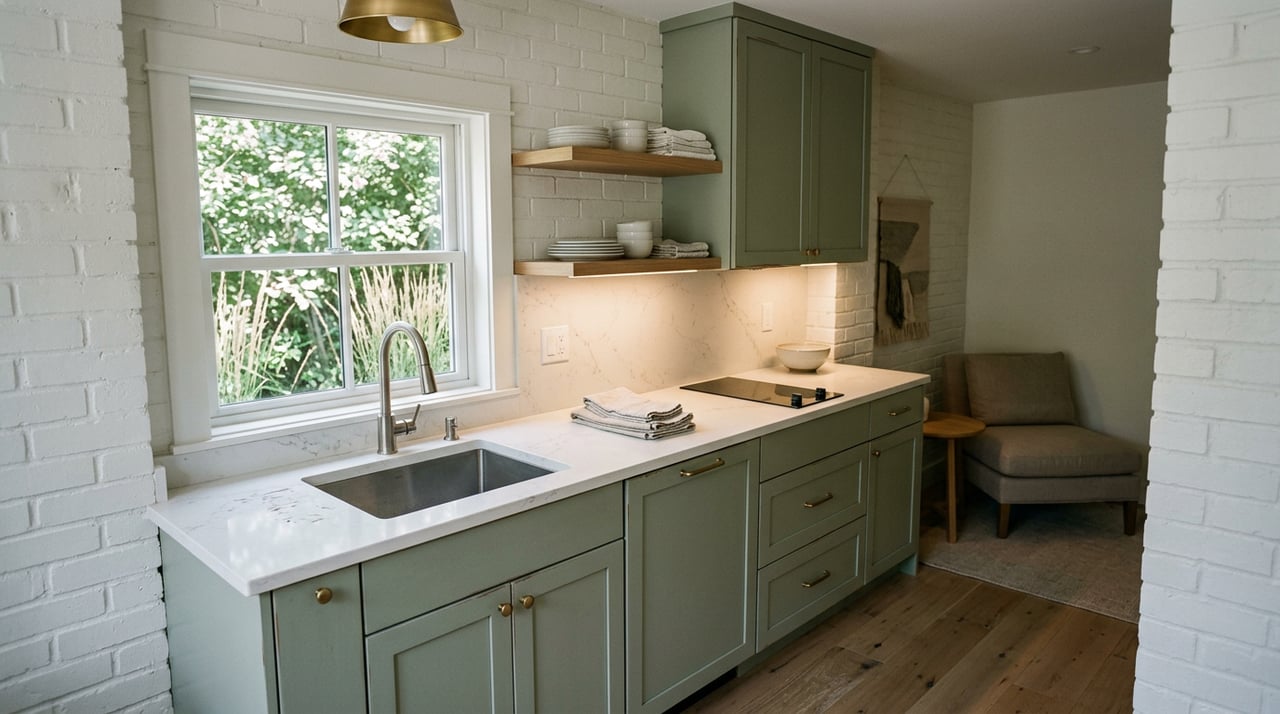
A buyer we talked with this summer had already done the math twice. She'd found a two-bedroom bungalow near a listing that was pulling strong nightly rates on a booking platform, penciled out the mortgage against projected occupancy, and was ready to write an offer built on the assumption that Denver would let her run it as a short-term rental. It wouldn't. Not because of the house. Because of where she planned to sleep at night.
That's the piece of Denver's short-term rental rule that trips up more buyers than any pricing surprise: the city doesn't license properties. It licenses people, and only at the one address where they actually live.
The rule under the math
Denver has allowed short-term rentals since Denver City Council adopted Council Bill CB16-0262 on June 13, 2016. The ordinance took effect January 1, 2017, and it lives in Denver Revised Municipal Code Chapter 33, Article III. Almost a decade later, the core of it hasn't moved: a short-term rental license can only attach to a host's primary residence, and investor-owned, non-owner-occupied units simply don't qualify for one.
That single condition is the whole ballgame for anyone evaluating a Denver property as a nightly-rate income stream. It means the strategy that works in plenty of other markets, buy a second property and list it, doesn't exist here as a legal path. You can host in the home you live in. You cannot buy a separate unit purely to run it as an Airbnb.
What "primary residence" actually has to prove
The city's own definition is specific, and it's worth reading exactly as written:
The place in which a person's habitation is fixed for the term of the license and is the person's usual place of return.
That's not a vibe. Denver checks it against your driver's license, your voter registration, your vehicle registration, and the address on your tax filings. A license can only attach to one person's one primary residence, which is also why an individual can hold exactly one short-term rental license at a time. Buy three condos hoping to license all three because you technically own them all is not a workaround. It never has been.
If you're a tenant rather than an owner, the same rule applies to you, with one extra step: you need written permission from your landlord on file before the city will consider your application.
The workaround that actually works
None of this means Denver has closed the door on rental income entirely. It just narrows the door to a specific shape.
An accessory dwelling unit attached to your primary residence, a basement suite, a carriage house, a garage conversion, can be licensed for short-term use because it sits on the lot where you already live and satisfies the primary-residence test automatically. Renting a spare room in the house you occupy works the same way. Neighborhoods like Chaffee Park and Sloan's Lake have updated their zoning specifically to make ADU construction easier, which is part of why buyers interested in a rental income component often start their search there rather than chasing a stand-alone investment property downtown.
The cost of building that ADU is its own decision. Detached units in Denver typically run $250,000 to $400,000 or more, while converting an existing basement into a legal suite tends to start closer to $100,000. That's a real capital outlay to weigh against projected nightly income, not a shortcut.
Cross the city line and the rule changes
Here's the part that surprises people who assume "Colorado" means one set of rules: it doesn't. Drive a few miles in almost any direction and the short-term rental math resets.
| City | Owner-occupancy required? | Notable detail |
|---|---|---|
| Denver | Yes | License limited to one primary residence per person; investor-owned units excluded |
| Lakewood | Yes | City council considered allowing non-resident investor licenses and wrote that option out of the final ordinance |
| Arvada / Wheat Ridge | No (by informal market accounts) | Real estate forum commentary describes both as permitting non-owner-occupied short-term rentals, with Arvada reportedly not requiring a license at all |
| Boulder | Yes, and stricter | Owner must be on-site during the rental period, which rules out whole-home hosting while you're away |
Lakewood's ordinance, adopted as O-2023-5 and effective September 1, 2023, mirrors Denver's owner-occupancy stance almost exactly. City council members debated letting non-resident owners in, then removed that provision before the final vote. If you're comparing a Denver purchase against a Lakewood one because you saw similar listing prices, the Airbnb math isn't actually similar. It's identical in structure and equally closed to a pure investment play.
Boulder goes a step further than either. Its owner-occupancy requirement adds a condition Denver doesn't have: the host has to be physically present during the stay. That effectively eliminates the whole-home, owner-away model that's common on booking platforms elsewhere, and the city has been selective about issuing new licenses in its denser residential neighborhoods on top of that.
Arvada and Wheat Ridge sit on the other side of the line. Market commentary from investors active in the Denver metro consistently describes both cities as allowing non-owner-occupied short-term rentals, with Arvada in particular reportedly not requiring a license at all for that use. If a straightforward buy-to-Airbnb plan is the goal, that's the kind of jurisdictional detail worth confirming before you fall in love with a Denver listing that can't legally support it.
What enforcement actually risks in 2026
Denver isn't relying on the honor system to keep this rule intact. The city uses third-party monitoring software that scans more than 25 booking platforms looking for listings operating without a valid license number, and neighbor complaints filed through the 311 system trigger investigations on their own. Annual license audits cross-reference the same primary-residence documentation you submitted at application, so the check doesn't end once you're approved.
The penalties scale with how far someone tries to bend the rule. Operating without a license has historically drawn fines in the range of several hundred dollars up to roughly $999 per violation. Falsifying primary-residence information to get a license you don't actually qualify for is a different category of problem: Colorado law treats that as a felony, punishable by two to six years in prison and fines up to $500,000. That's not a cost of doing business. That's the kind of number that should end the conversation before someone tries the workaround.
What the income numbers actually say
Even for hosts operating fully within the rules, Denver's short-term rental market in 2026 isn't the sure thing it might look like from a portal's projected-earnings tool. Recent market data puts the average Denver host's annual earnings around $30,143, with peak revenue landing in July at roughly $4,908 for the month, occupancy near 65.2%, and average daily rates around $219. January is consistently the slowest month by comparison.
The more useful number for anyone underwriting a purchase is the trend line, not the peak. Early 2026 data flags Denver among the markets seeing declining occupancy as the local short-term rental supply grows faster than demand. Roughly 71% of active Denver listings show valid registration under the current rules, which tells you compliance has become close to table stakes rather than a competitive edge, and it's one more reason to run your own numbers conservatively instead of anchoring to someone else's best month.
What this means if you're deciding where to buy
None of this makes a Denver purchase a bad idea if rental income matters to you. It changes what kind of purchase you're actually making. In Denver and Lakewood, you're buying a home to live in that happens to carry a legal side income if you follow the rules closely. In Arvada or Wheat Ridge, by current market accounts, you're closer to buying an actual investment property in the more traditional sense. In Boulder, you're buying a home where hosting means sharing space with a guest while you're there, not stepping away for a week.
The property doesn't decide which of those you get. The address does, and the city line you're standing on when you sign.
A short FAQ
Can I buy a Denver rental property and just live there part-time to qualify? No. Denver's definition of primary residence is "the person's usual place of return," and the city cross-checks that against your ID, voter registration, and tax filings rather than taking your word for it.
What if my HOA allows short-term rentals but the city doesn't license my situation? Both have to say yes. An HOA's approval doesn't override the city's primary-residence requirement, and the city's license doesn't override an HOA that prohibits short-term rentals in its governing documents.
Does the license fee make a real difference in the numbers? Guides published this year cite figures anywhere from about $25 a year to $150 for a two-year term, depending on which fee schedule and renewal cycle you're reading. Confirm the current number directly with Denver's Excise and Licenses office before you build it into a budget, since it's a small line item next to the primary-residence question but still worth getting right.
If you're weighing a Denver property against something in Lakewood, Arvada, or Boulder and rental income is part of the decision, that's exactly the kind of question worth sitting down over before you write an offer. Gather Realty has spent years helping buyers think through what a property can actually do, not just what a listing promises. Schedule a consultation and we'll walk through the specific address, not the general rule.